Waste Management Statistics UK
Waste management is a critical part of how UK businesses operate, shaping everything from daily efficiency to long-term sustainability goals. As environmental expectations rise and general waste service options expand, understanding what business leaders value most has never been more important.
To find out what 160,688 opinions of business leaders in the UK who use waste management services were, we used AI-driven audience profiling to synthesise insights from online discussions for a full year, ending on the 19th November, 2025, to a high statistical confidence level. The results reveal the importance of sustainable waste solutions, what matters most in waste management, challenges and preferences, and other interesting viewpoints.
Index
- Improved sustainability is a top motivator for 17% of business leaders in the UK who use waste management services to try a new option
- 46% of business leaders in the UK who use waste management services are in the manufacturing sector
- 61% of business leaders in the UK who use waste management services say that time savings are a significant reason for using a professional provider
- Composting is the main method of handling food waste for 45% of business leaders in the UK who use waste management services
- 19% of business leaders in the UK who use waste management services say packaging waste is quite common
- 34% of business leaders in the UK who use waste management services say higher recycling rates are a top priority
- 23% of business leaders in the UK who use waste management services say their staff are very interested in waste reduction training
- 73% of business leaders in the UK who use waste management services agree that simple summaries are quite a valuable type of waste reporting
- 72% of business leaders in the UK who use waste management services say that more recycling solutions are absolutely needed to improve waste services
- 60% of business leaders in the UK who use waste management services say that customer support is the main factor that influences which provider they use
- Irregular collection is somewhat challenging for 20% of business leaders in the UK who use waste management services
- Wheelie bins are the perfect fit for 23% of business leaders in the UK who use waste management services
- 66% of business leaders in the UK who use waste management services are located in London
- The Future of Waste Management in the UK
- About the Data
What Motivates You To Review New Waste Management Service Options?
Improved sustainability is a top motivator for 17% of business leaders in the UK who use waste management services to try a new option
Motivations vary for trying new service options:
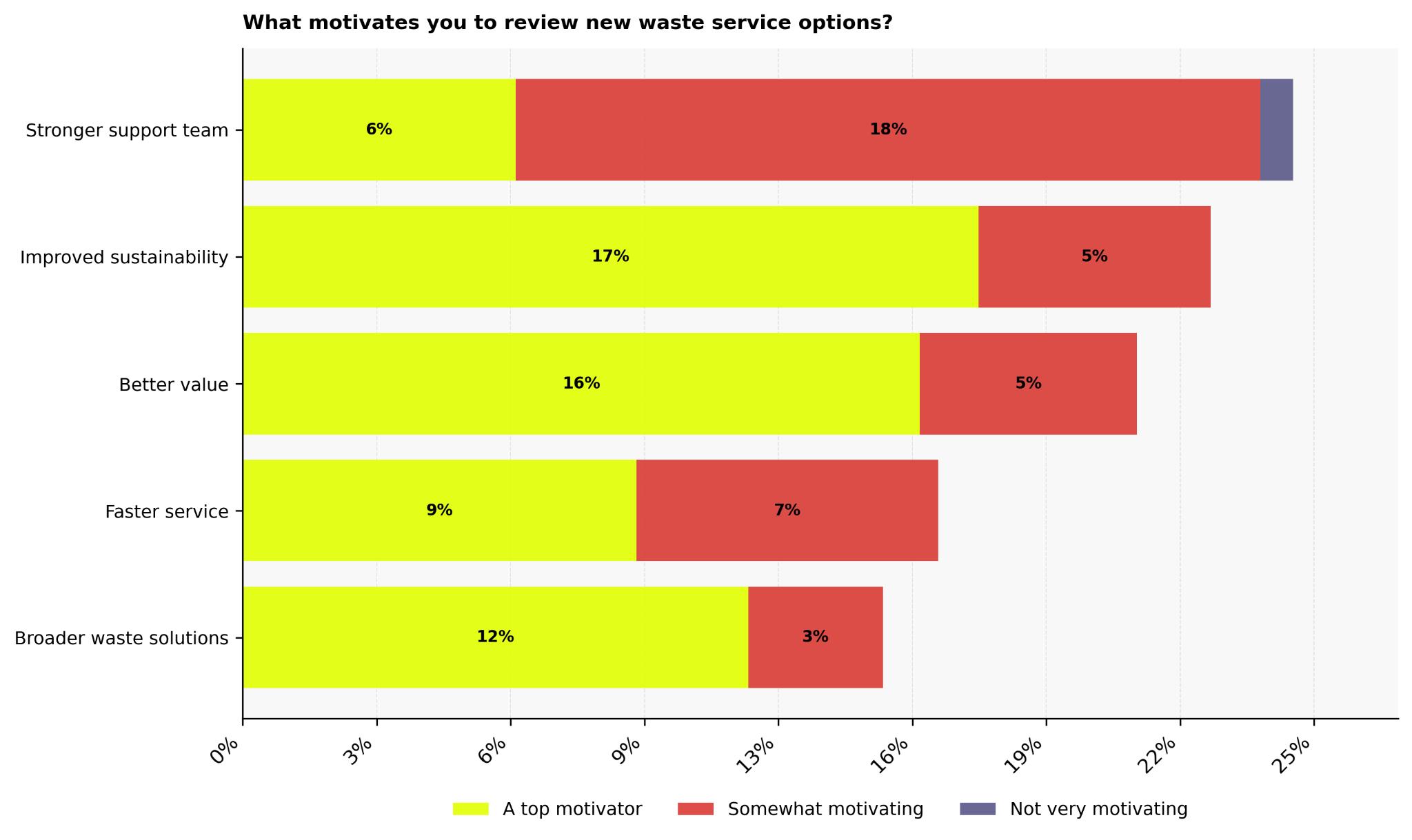
Although the highest number (17%) of business leaders’ top motivator for reviewing new waste service options was improved sustainability,
and another 5% found this somewhat motivating, there has been a drop in the UK in the number of people concerned about climate change.
A 2024 report
from the Office for National Statistics found that the number of businesses concerned about the impact of climate change decreased
from 34% in June to 28% in September.
Another top motivating factor for reviewing new waste management service options was better value (16%),
while 5% said this was somewhat motivating.
Next were broader waste solutions as a top motivator for 12% and somewhat motivating for 3%,
followed by faster service (9% top motivator and 7% somewhat motivating).
Then came a stronger support team, with just 6% saying this was a top motivator
and 18% saying it’s somewhat motivating.
This suggests that while sustainability is a focus, there are many other factors that encourage the review
of new providers that are almost as motivating.
What Industry Sector Are You In?
46% of business leaders in the UK who use waste management services are in the manufacturing sector
Our audience works in five predominant industries:
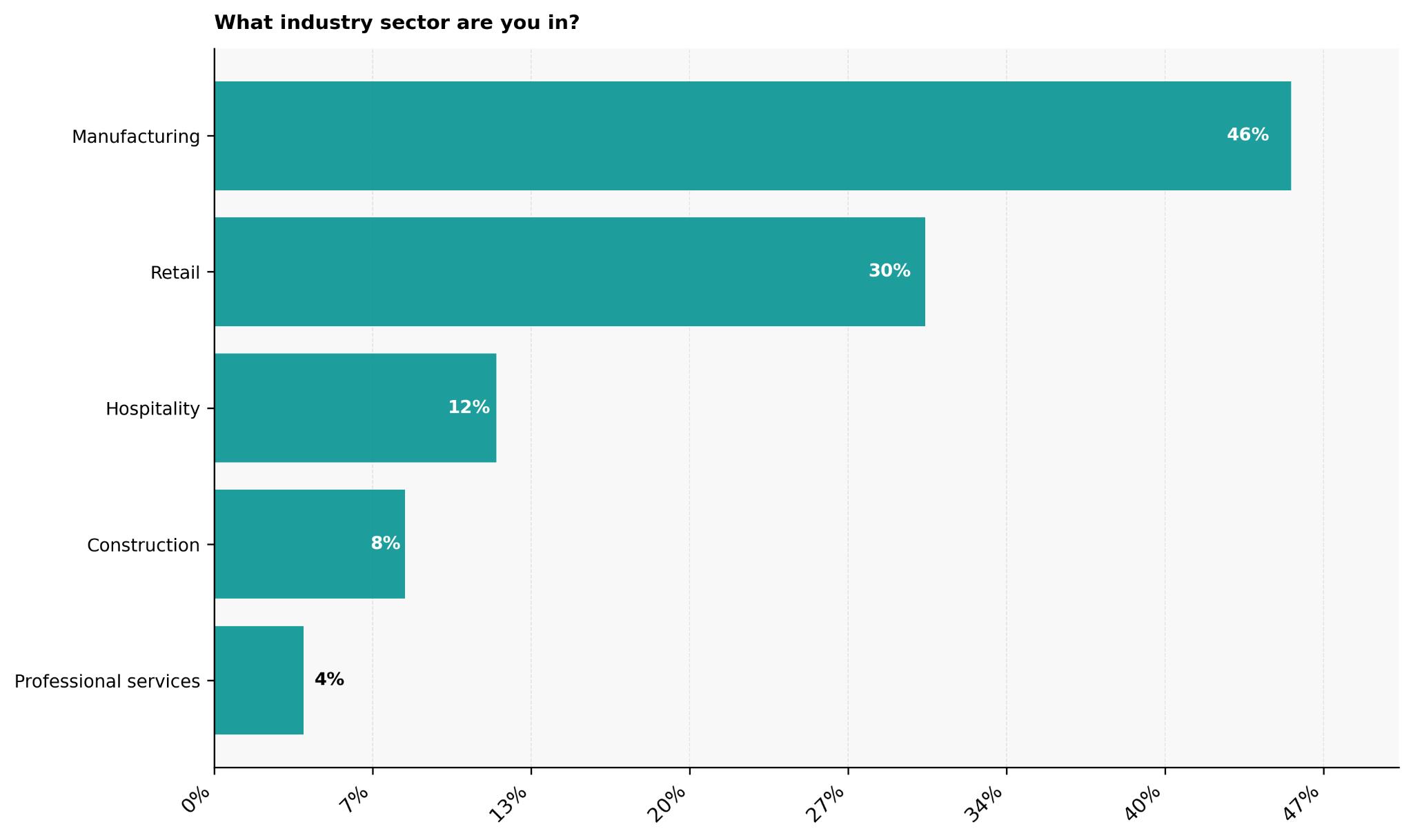
Nearly half (46%) of our audience is in the manufacturing industry, making it understandable why they’d use waste management services.
In 2020, around 40.4 million tons
of commercial and industrial waste were generated, making it a major contributor to landfills. Retail comes next with 30%,
followed by hospitality (12%), construction (8%), and professional services (4%).
This spread likely also aligns with the amount of waste produced, with industries like retail and hospitality
being large product consumers.
What Is Your Main Reason For Using A Professional Waste Management Provider?
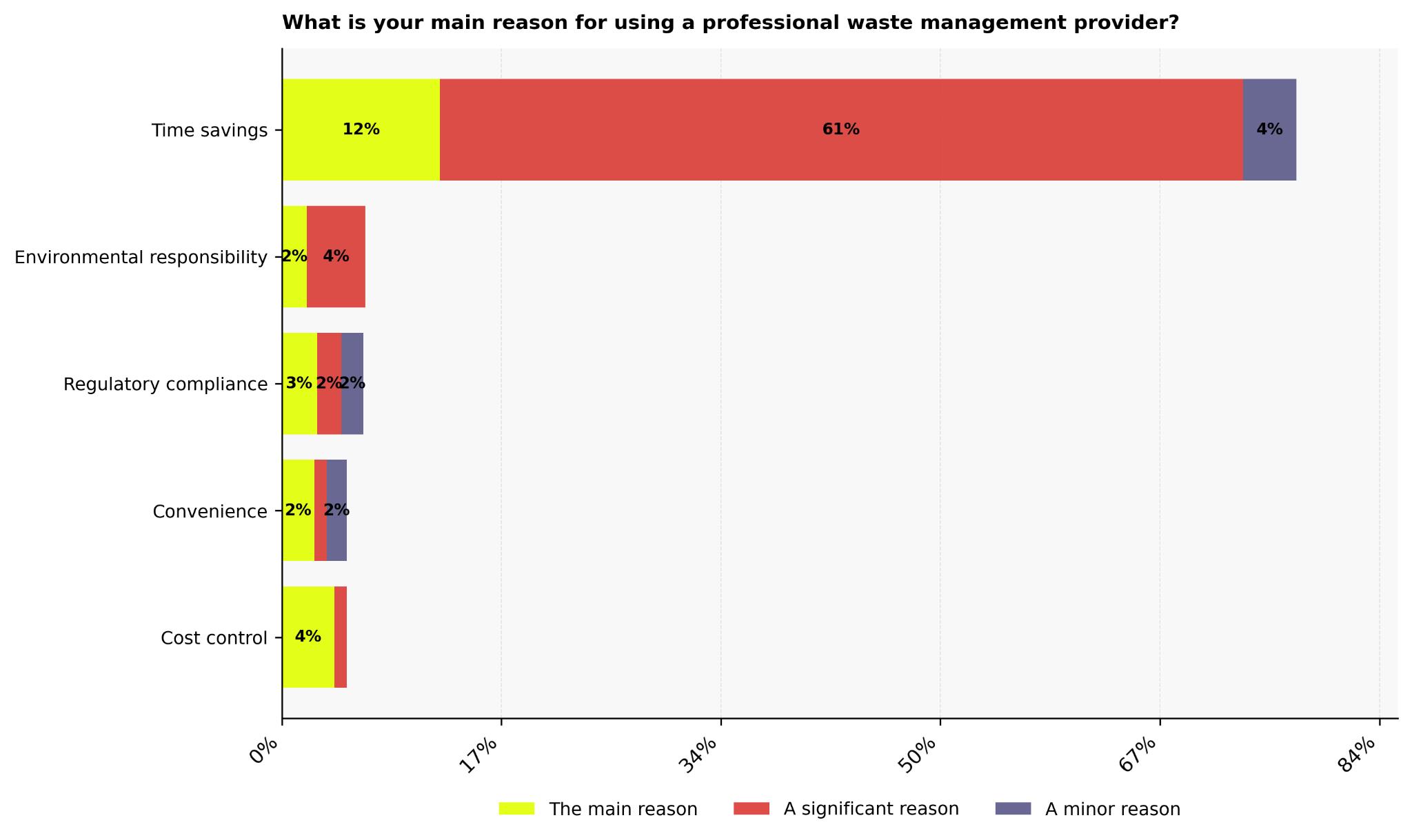
61% of business leaders in the UK who use waste management services say that time savings are a significant reason for using a professional provider
How Do You Currently Handle Food Waste?
Composting is the main method of handling food waste for 45% of business leaders in the UK who use waste management services
Clear trends emerge in the current handling of food waste:
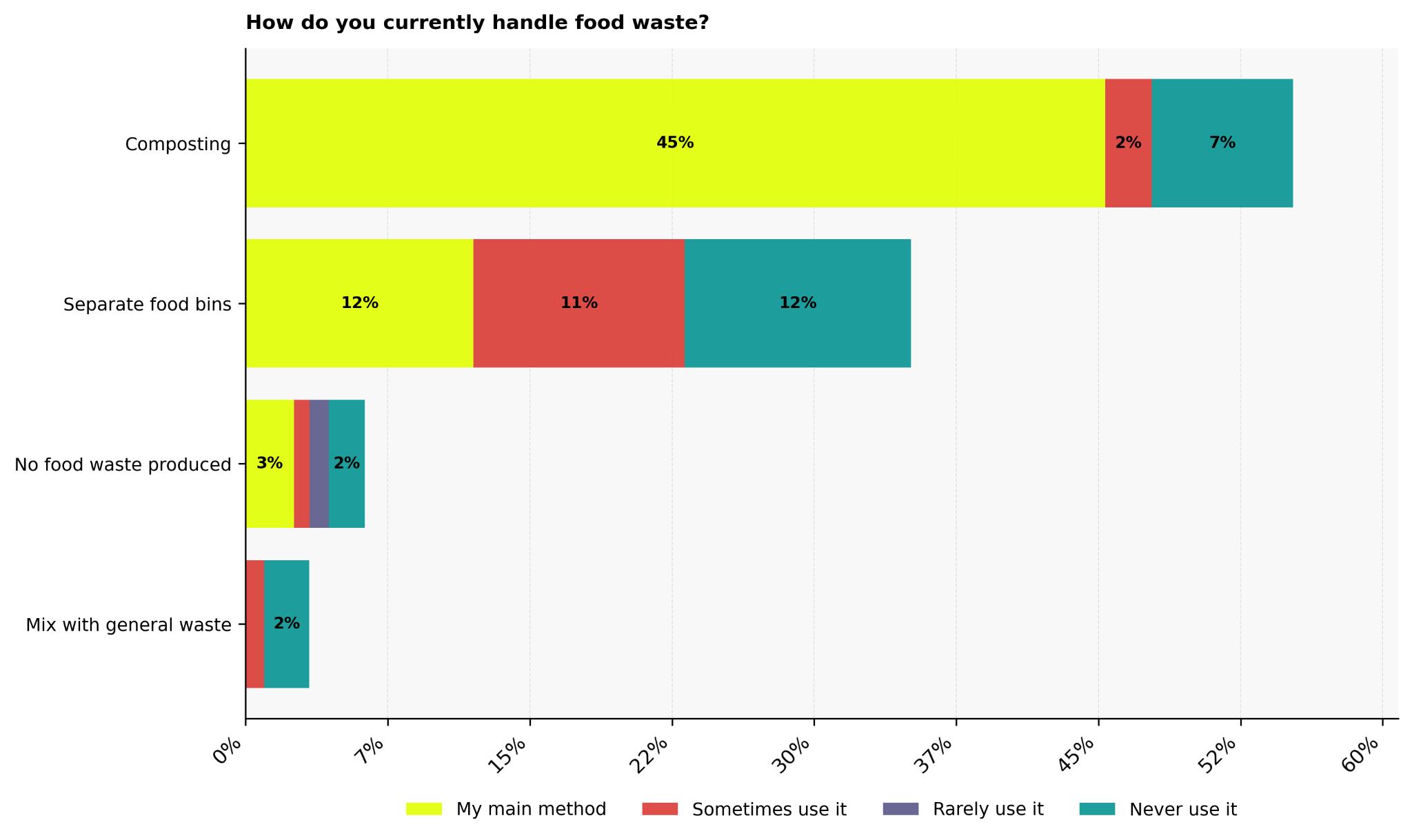
With the UK wasting approximately
10.2 to 10.7 million tonnes of food
annually, it’s positive to see that at least half of our audience of business leaders using waste management services
say that composting is their main method for handling food waste. Another 2% sometimes use composting, and only 7% say
they never use it.
Separate food bins are the main method of dealing with food waste for 12% and 11% sometimes use them, while another
12% never use them. Only a small percentage (5%) say that no food waste is produced, and 2% never mix food waste with
general waste. Based on these opinions, it’s encouraging to see so many business leaders using composting to handle
food waste.
What Type Of Waste Do You Generate Most Often?
19% of business leaders in the UK who use waste management services say packaging waste is quite common
Two types of food waste are generated the most:
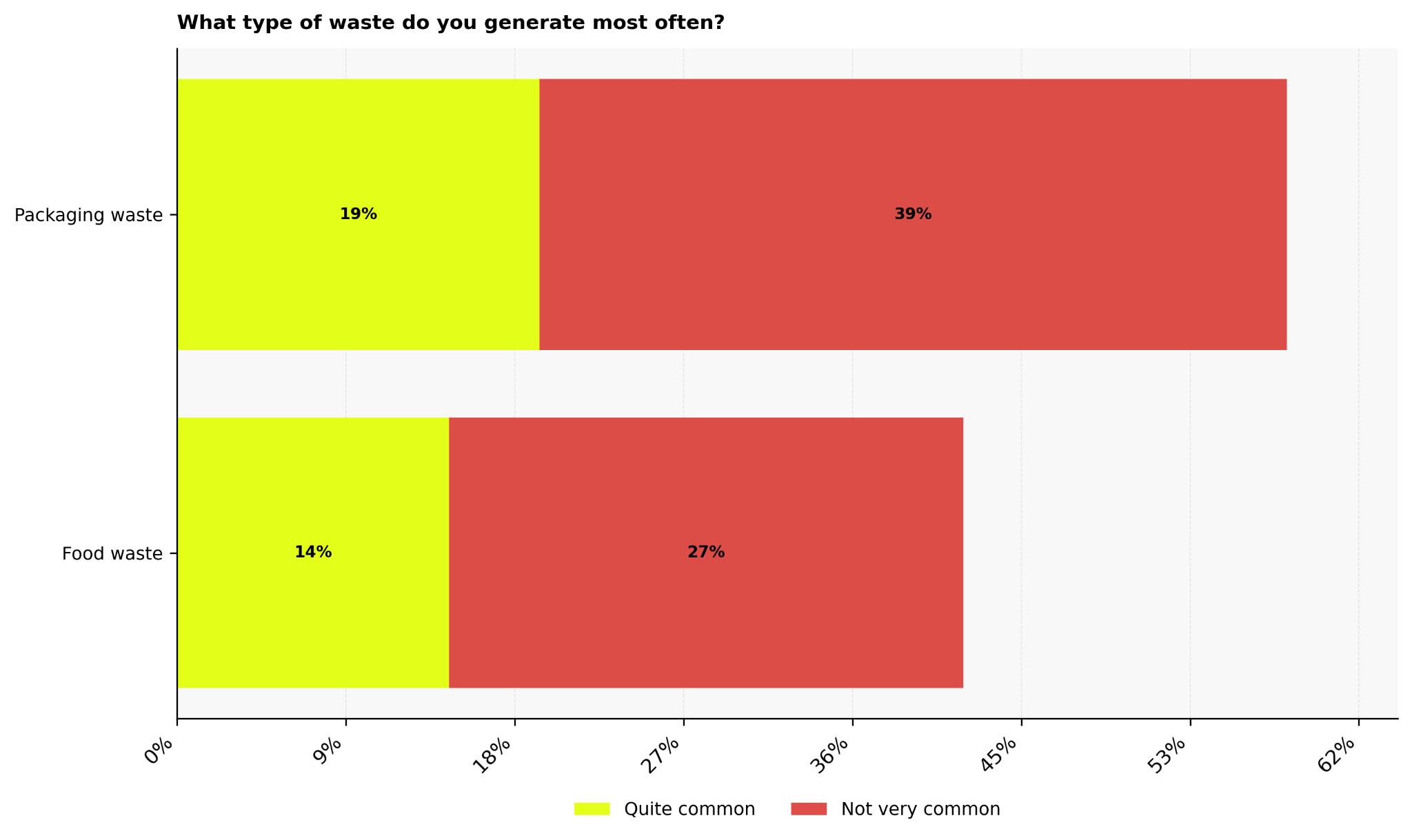
Although only 5% of our audience said they produced no food waste, 14% say this is the type of waste they generate quite commonly, and 27% say that it is not very common. Slightly more (19%) say that packaging waste is quite common, and 39% say it’s not very common, putting it a little ahead of food overall.
What Recycling Priority Matters Most To You?
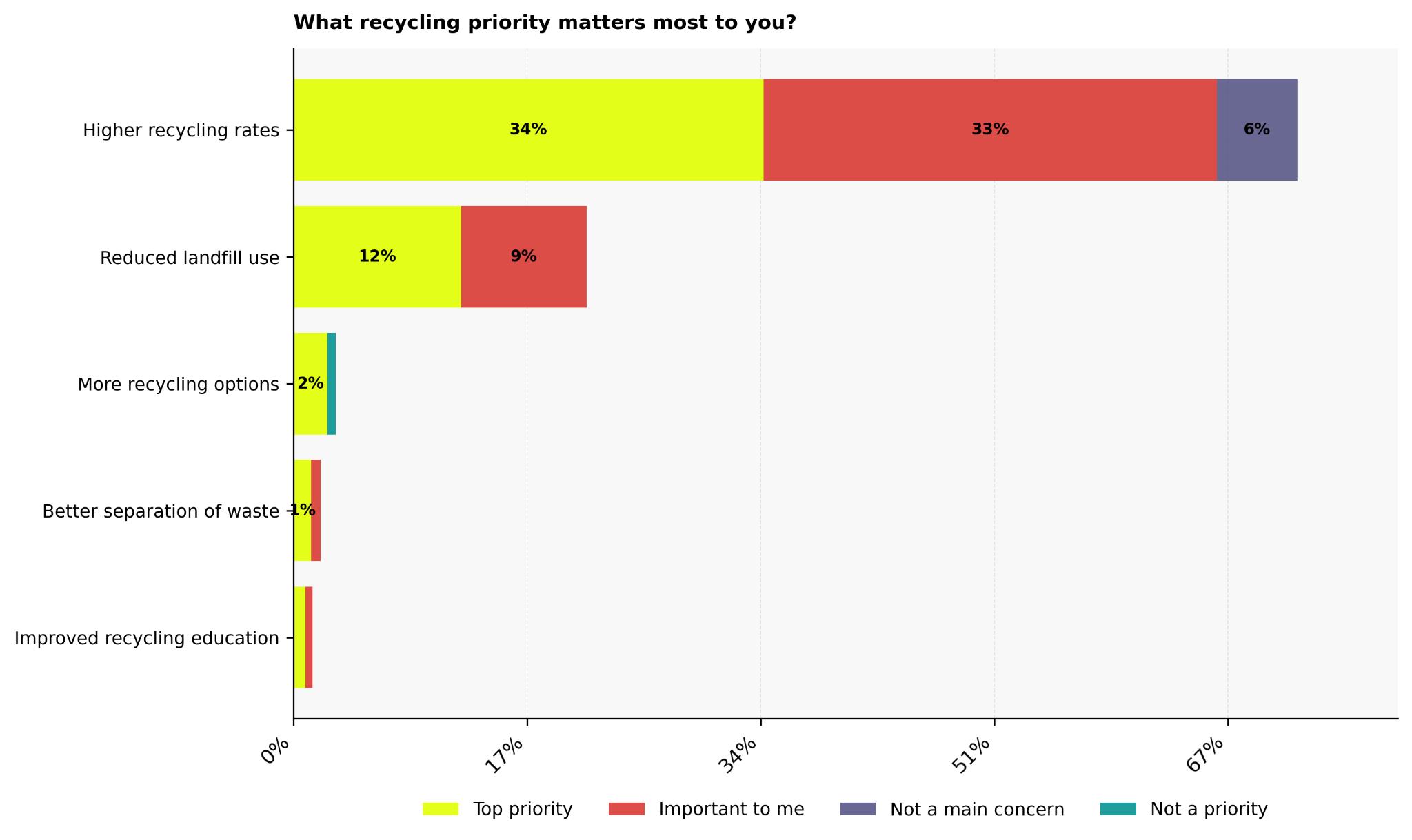
34% of business leaders in the UK who use waste management services say higher recycling rates are a top priority
One main priority for recycling is evident:
With households in the UK recycling
44.1% of their waste,
it’s encouraging to see that a large number of businesses are also prioritising recycling.
34% of our audience say that higher recycling rates are a top priority in this regard,
while 33% say it is important to them. Conversely, only 6% say it’s not a main concern.
Reduced landfill use is a top priority for 12% and important to 9%, while 2% cite more recycling options as a top priority,
and 1% feel the same about better separation of waste. Less than 1% said improved recycling education,
suggesting that most are aware of the importance of doing so.
How Interested Are You In Staff Training For Waste Reduction?
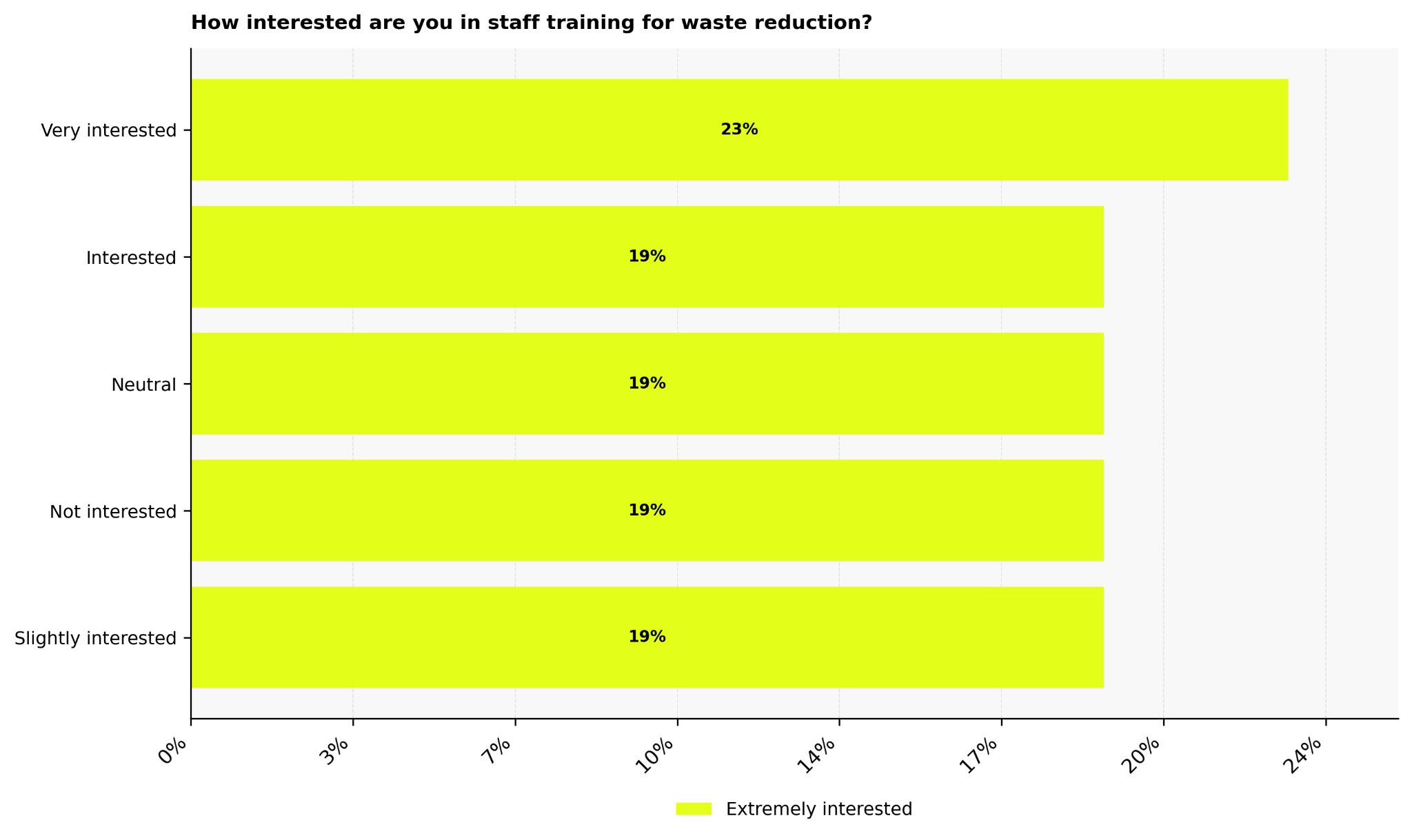
23% of business leaders in the UK who use waste management services say their staff are very interested in waste reduction training
Interest levels in staff training are generally high:
In the UK, there are
national standards for training
in many areas of waste management. However, these do not necessarily cover waste reduction.
It’s therefore encouraging that our audience is largely interested in staff training for waste reduction.
23% are very interested, 19% are interested, another 19% are slightly interested,
and yet another 19% are neutral. Only 19% say they are not interested, which may indicate that
their staff are not involved in waste management and would not benefit from this type of training.
What Type Of Waste Reporting Do You Value Most?
73% of business leaders in the UK who use waste management services agree that simple summaries are quite a valuable type of waste reporting
Simplicity is preferred in waste management reporting:
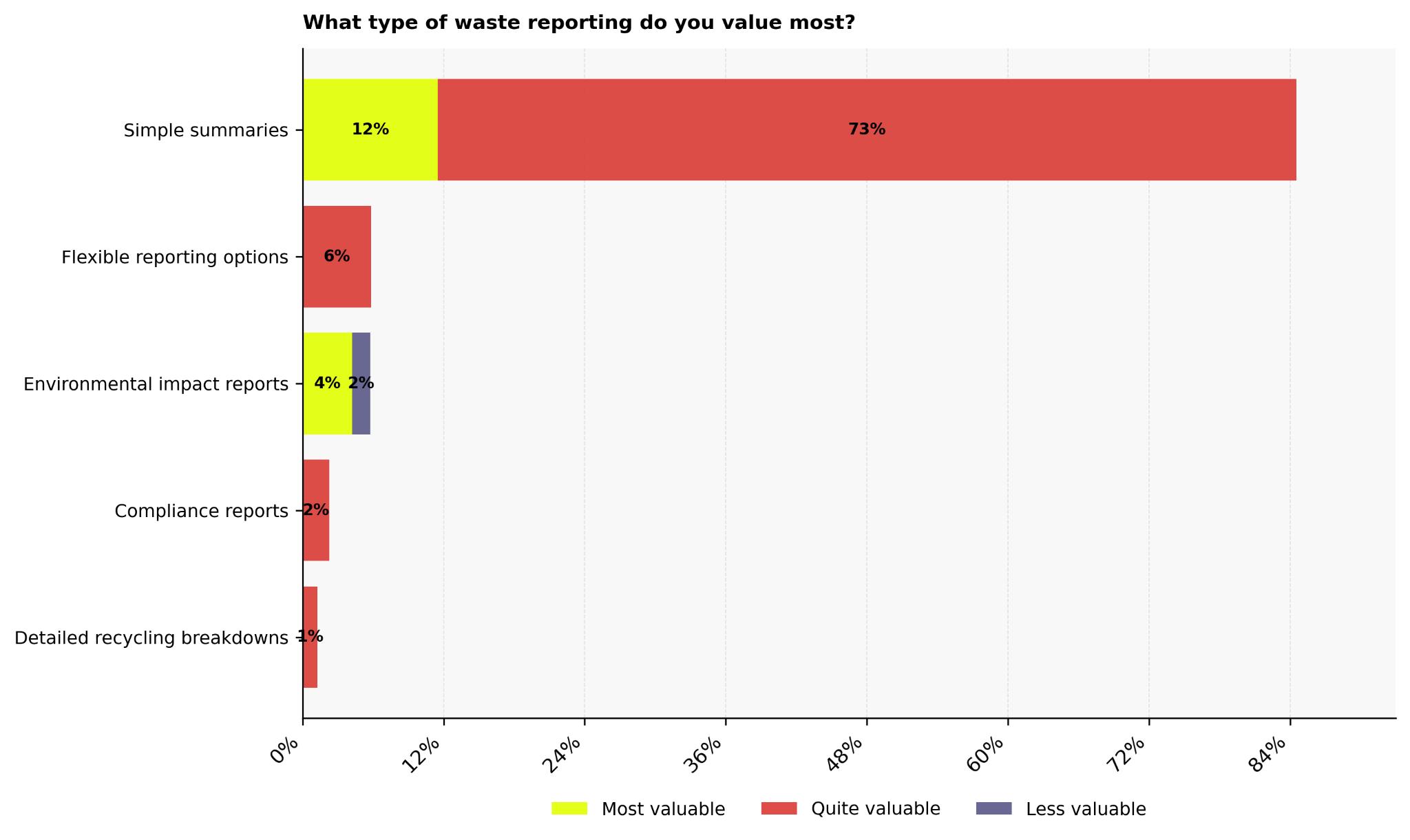
For our audience of business leaders who use waste management services in the UK, there’s a definite preference
for simple waste reporting summaries. 73% say they find these quite valuable, and 12% most valuable, in contrast
to the 6% who find flexible reporting options quite valuable. Just 4% say that they find environmental impact
reports most valuable and 2% less valuable, while 2% say that compliance reports are quite valuable and 1% feel the
same about detailed recycling breakdowns.
Given the
growing emphasis on ESG reporting across UK businesses, these statistics are surprising as they show that,
despite wider industry pressure to demonstrate environmental impact and compliance, most leaders still prioritise
straightforward, digestible summaries over detailed ESG-driven reporting.
What Improvement Would You Like To See In Waste Management Services?
72% of business leaders in the UK who use waste management services say that more recycling solutions are absolutely needed to improve waste services
One improvement stands out above all others:
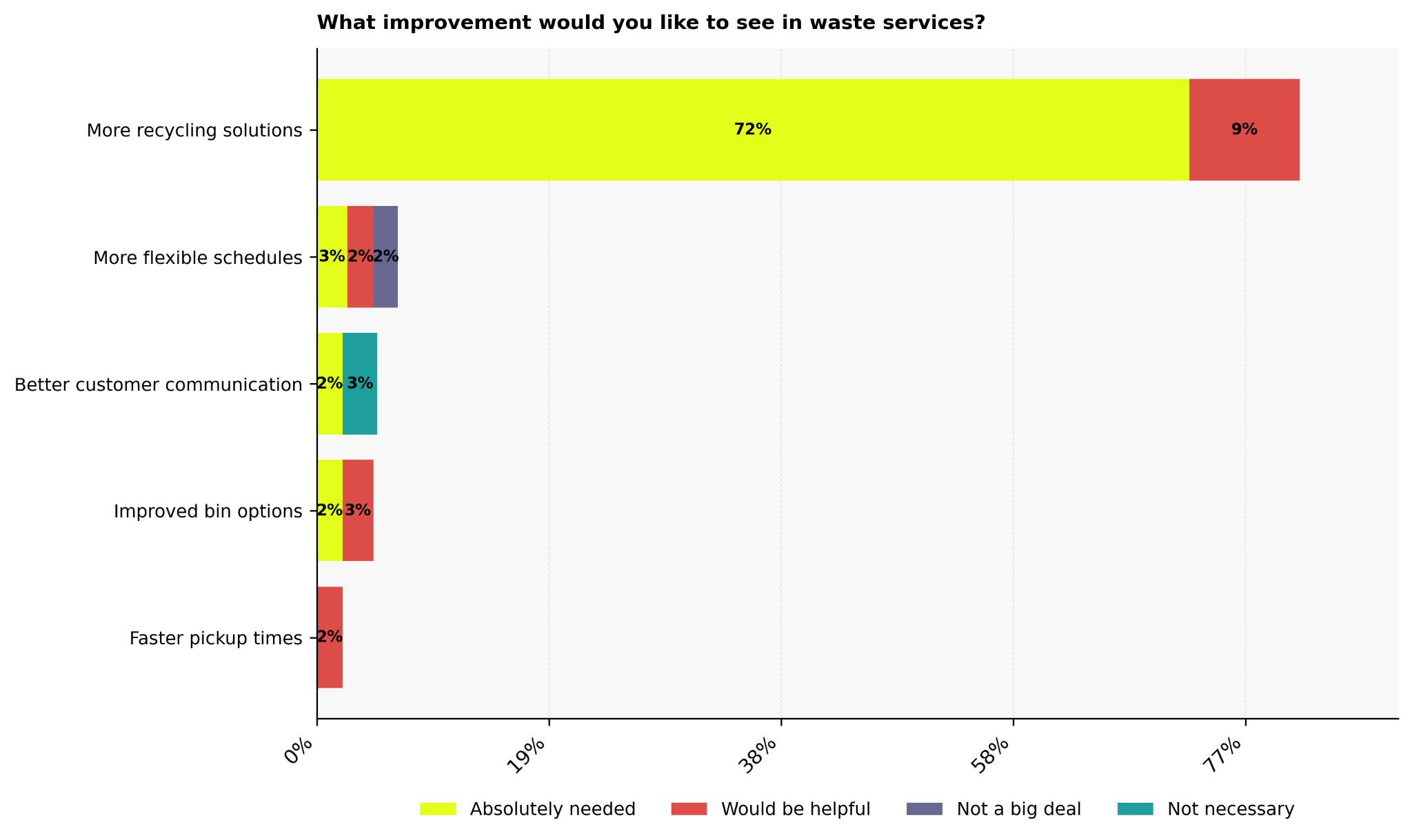
The one improvement business leaders who use waste management services would like to see the most is more recycling solutions.
72% say this is absolutely needed, and 9% agree it would be helpful, showing that willingness to recycle is prevalent;
there just needs to be the opportunity to do so.
Other improvements, such as more flexible schedules, are absolutely needed by 3%, 2% say they would be helpful, and 2% consider
them not a big deal, better customer communication (2% absolutely needed and 3% not necessary), and improved bin options
(2% absolutely necessary and 3% would be helpful) and faster pickup times (2% say would be helpful) reveal where other
priorities and requirements lie.
What Factor Most Influences Your Choice Of A Waste Management Provider?
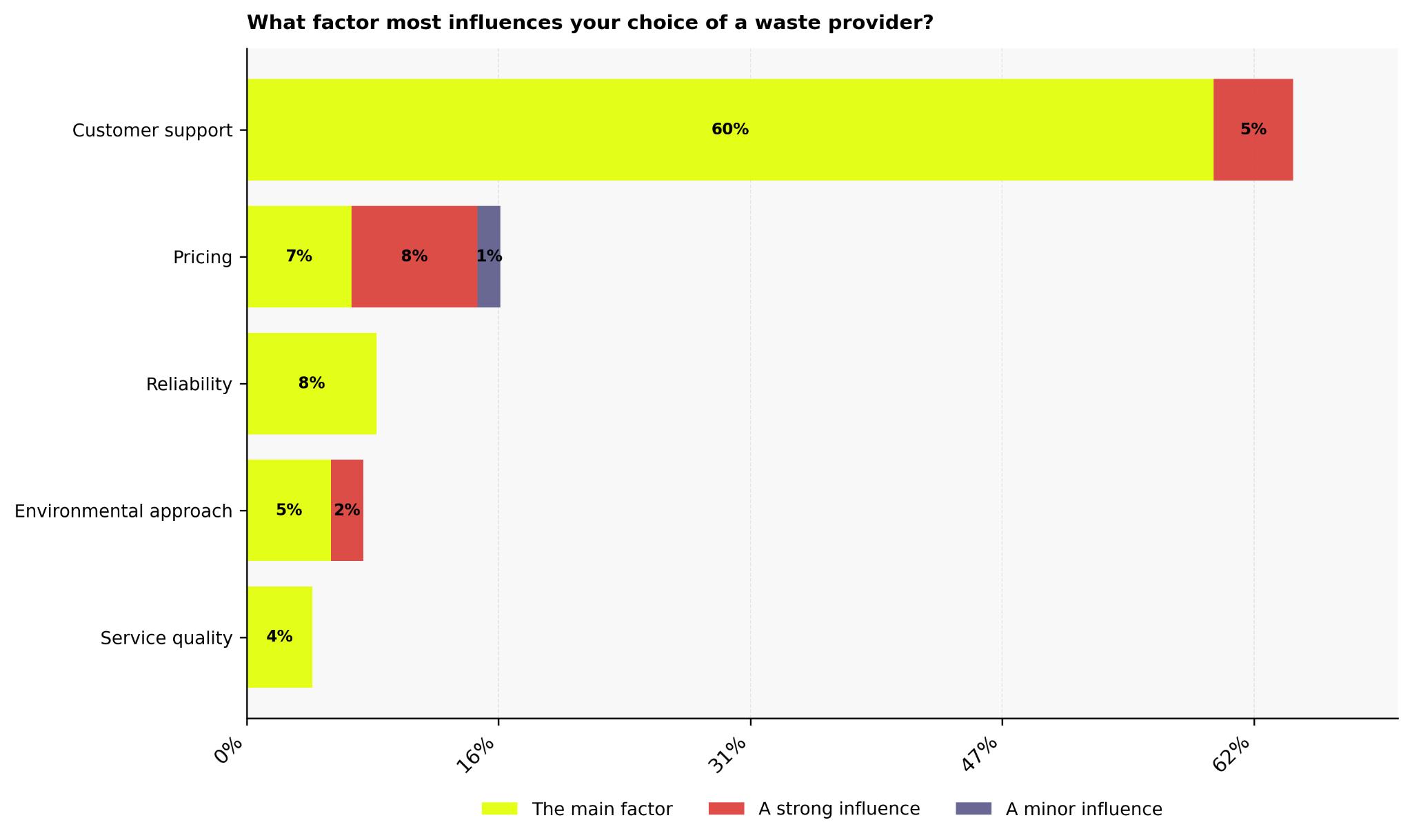
60% of business leaders in the UK who use waste management services say that customer support is the main factor that influences which provider they use
Support stands out as the most influential factor when choosing a provider:
Good customer support is crucial in any industry, with Gartner reporting that more than 80% of customers who have a great experience are more likely to repurchase a product or continue using a service.
This aligns with our audience’s opinions, with 60% of business leaders who use waste management services saying that customer support is the main factor that influences their choice of waste provider, and another 5% saying it’s a strong influence.
Pricing comes next, with 7% saying it’s the main factor, 8% that it’s a strong influence, and 1% a minor influence, followed by reliability as the main factor for 8%. Environmental impact was also mentioned as a main factor for 5% and a strong influence for 2%, while service quality was the main factor for 4%.
With customer service so far in the lead, especially ahead of pricing, it’s obvious that service far surpasses most other criteria when it comes to waste management.
What Is The Biggest Challenge You Face With Waste Collection?
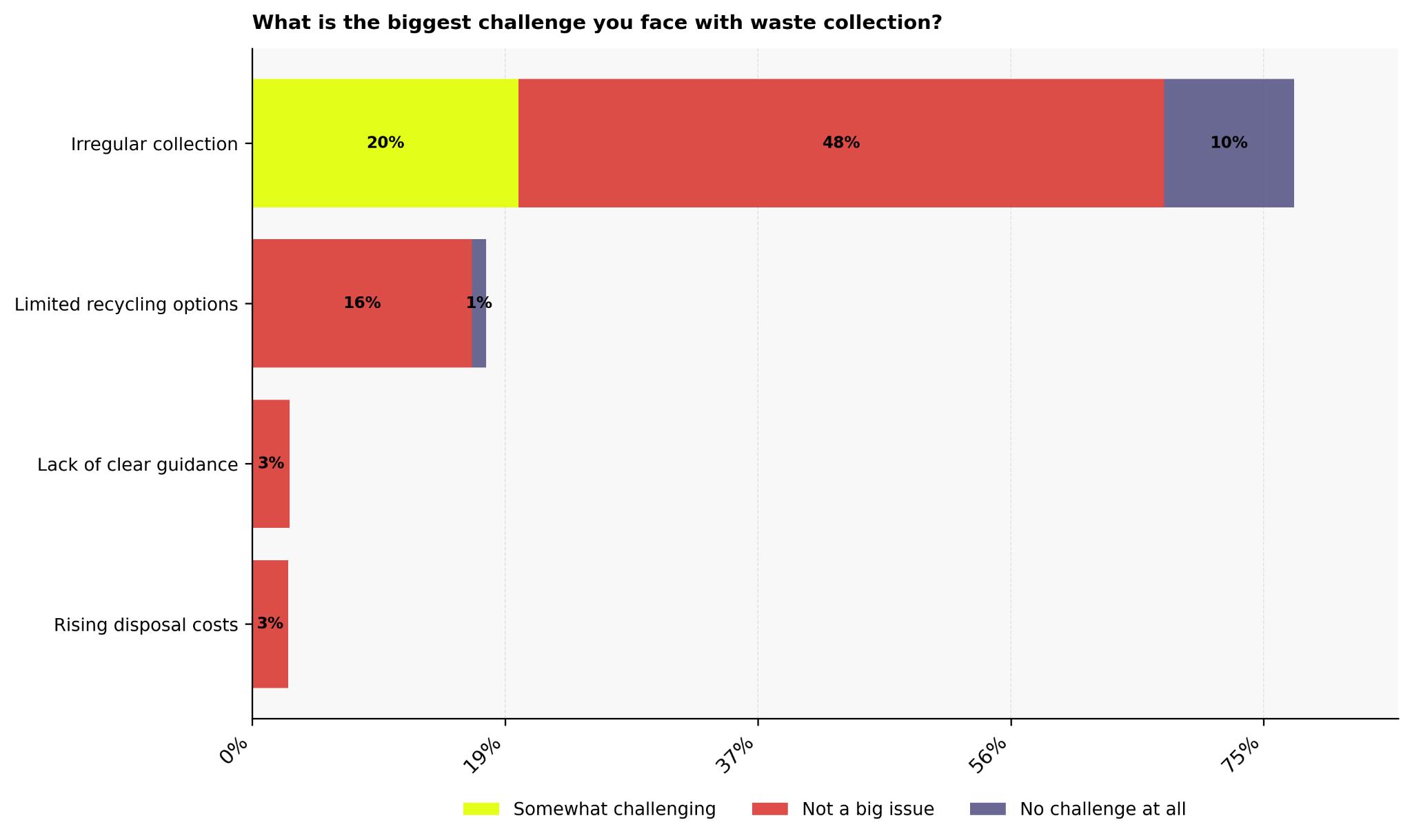
Irregular collection is somewhat challenging for 20% of business leaders in the UK who use waste management services
Waste collection challenges differ somewhat:
A study on the progress of waste management in achieving the UK’s net-zero goal found that the UK waste-management sector has achieved a 73% emissions reduction since 1990, but still faces significant gaps in aligning with the country’s 2050 net-zero target. With this target in mind, it’s interesting to note what our audience found most challenging about waste collection.
20% said that irregular collection was somewhat challenging, 48% said it wasn’t a big issue, and 10% it wasn’t a challenge at all. Limited recycling options were not a big issue for 16% and 1% said they were no challenge at all, while a lack of clear guidance and rising disposal costs were not a big issue for 6% of business leaders who use waste management services.
Overall, these numbers paint a positive picture, as they show that most users feel their current waste-collection systems are functioning well, leaving room for the industry to focus on higher-impact changes such as clearer communication, improved recycling infrastructure, and innovations that support the UK’s long-term net-zero ambitions.
What Type Of Bin Size Suits Your Business Best?
Wheelie bins are the perfect fit for 23% of business leaders in the UK who use waste management services
Bin type is essential in facilitating smooth waste collection:
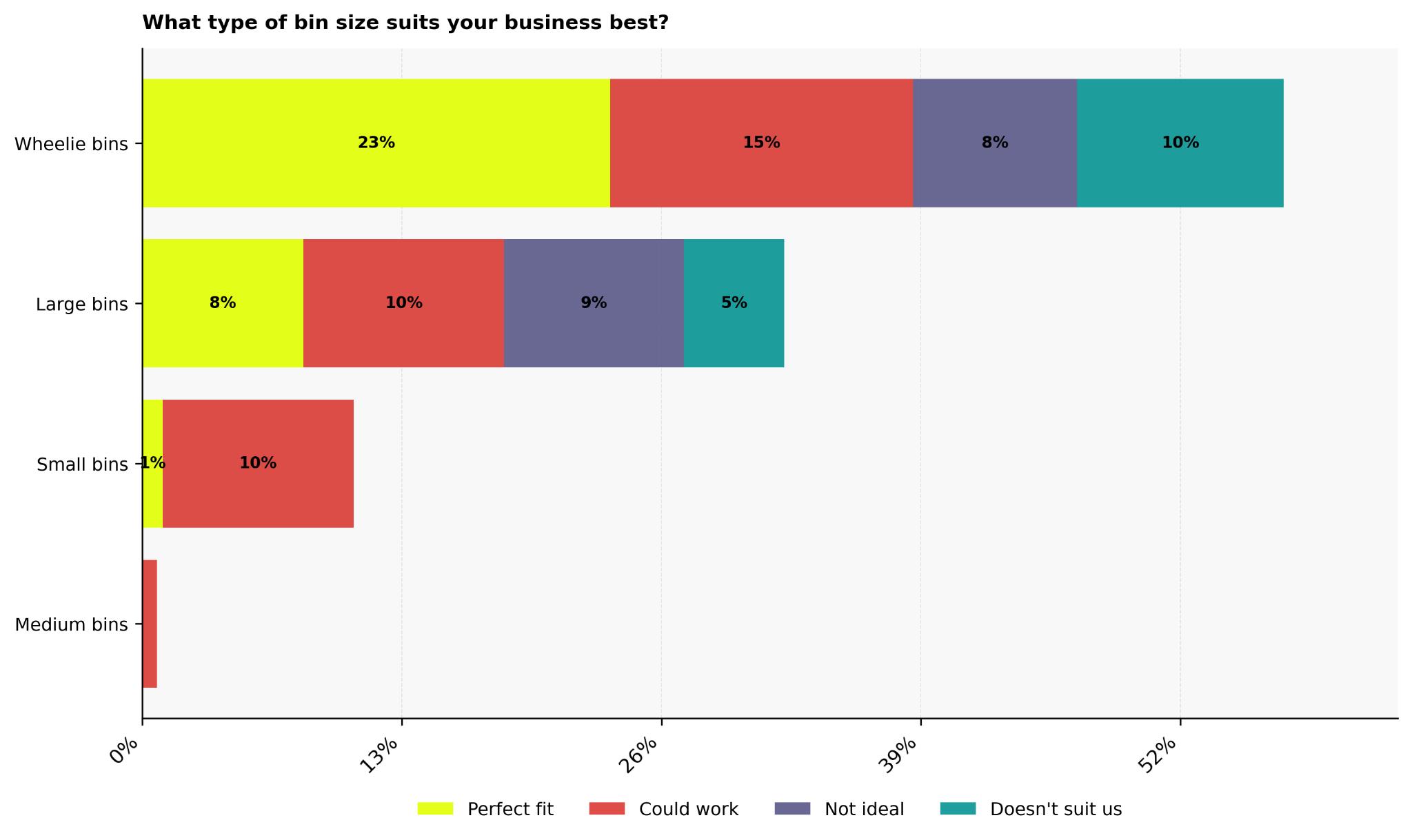
Wheelie bins are commonly used for household waste in the UK, but it seems many business leaders in our audience use them too. 23% say they are the perfect fit for their business, and 15% say they could work, compared to 8% who say they are not ideal and 10% who say they don’t suit them.
In comparison, large bins are the perfect fit for 8%, 10% agree they could work, 9% say they are not ideal, and 5% say they are unsuitable. Only 1% say small bins are the perfect fit, and 10% say they could work, and less than 1% have any opinion on medium bins.
This suggests that wheelie bins remain the most versatile and broadly accepted option among business users, offering a familiar, practical solution that outperforms smaller and larger alternatives in terms of overall suitability.
Which City Are You Located In?
66% of business leaders in the UK who use waste management services are located in London
Clear trends emerge in location:
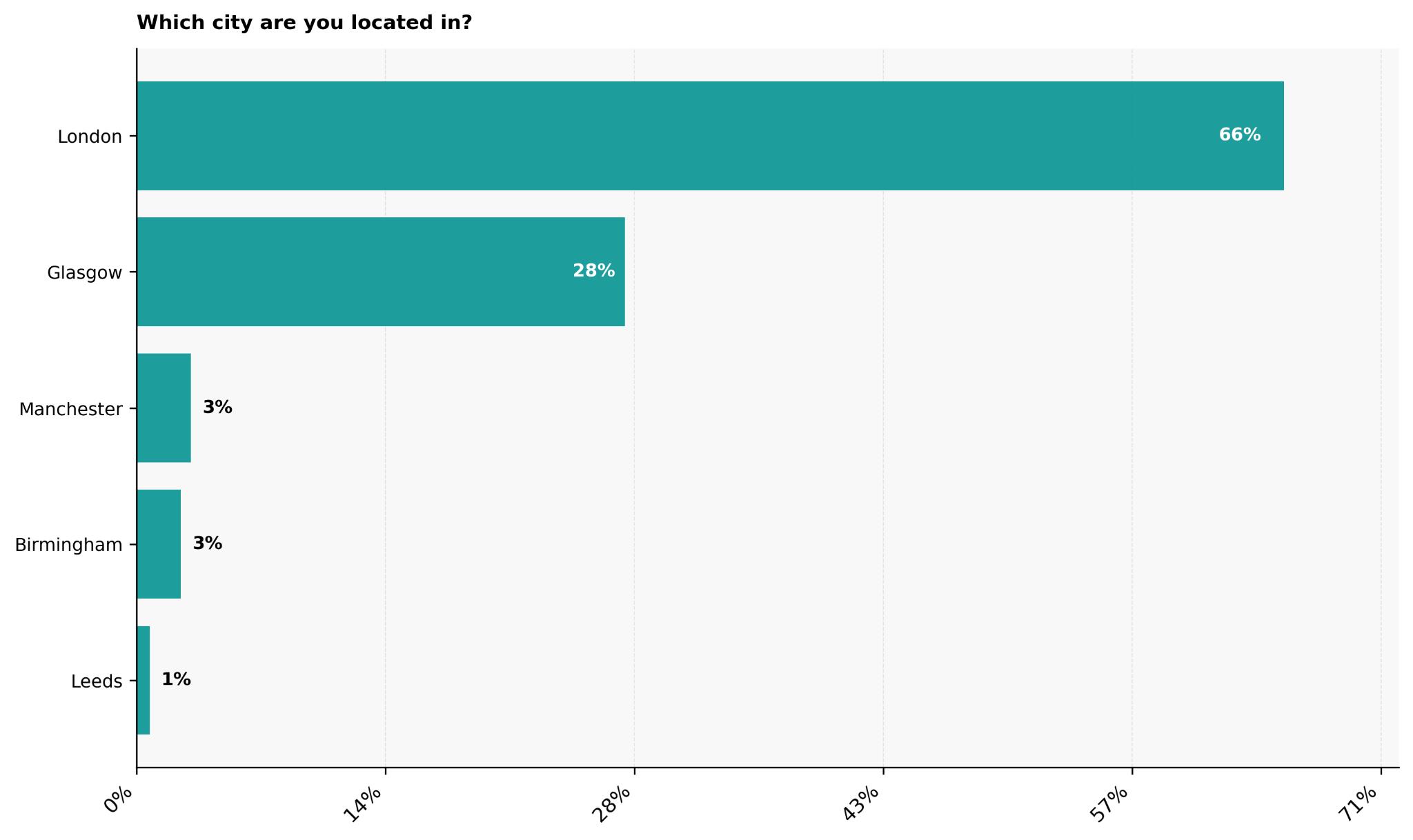
With London producing 18 million metric tonnes of waste and being a business hub, it’s understandable that 66% of our audience is based here. Glasgow, while also a hub, is far smaller, and 28% of our audience is located here, while Manchester and Birmingham have just 3% each and Leeds 1%, putting the focus firmly on the two cities.
The Future of Waste Management in the UK
Overall, these findings reveal that practicality, clarity, and strong support matter in waste management as much as sustainability. While many businesses are motivated by greener solutions, the emphasis on simple reporting, reliable collections, and better recycling options shows that ease and efficiency still drive most decisions.
Most business leaders also feel their current systems work well, but the call for improved recycling infrastructure and clearer communication highlights where the sector can make meaningful progress, especially as the UK continues working toward its 2050 net-zero goals.
About The Data
Sourced using Push from an independent sample of 160,688 opinions of business leaders that use waste management services in the UK, across X, Quora, Reddit, Bluesky, TikTok, and Threads. Responses are collected within a 95% confidence interval and 5% margin of error. Results are derived based on what people describe online, from opinions expressed, and not actual questions answered by people in the sample.

Get a quote for your business today!
 Operating across the whole of the UK
- Supplier placement flexibility
- No hidden fees
- 5 star Feefo service
Operating across the whole of the UKSupplier placement flexibilityNo hidden fees5 star Feefo service